Junming Zhao

Financial technology · Economics · Statistics

MEng in Financial Technology, Duke University (expected December 2027)
BA in Economics, minor in Statistics and Analytics, UNC Chapel Hill (2026)

adamzhao795@gmail.com

Three research projects on one question: when can you trust financial data, or the AI that reads it?

Accounting operations · AI agents

LedgerGym

A test range for AI bookkeeping agents.

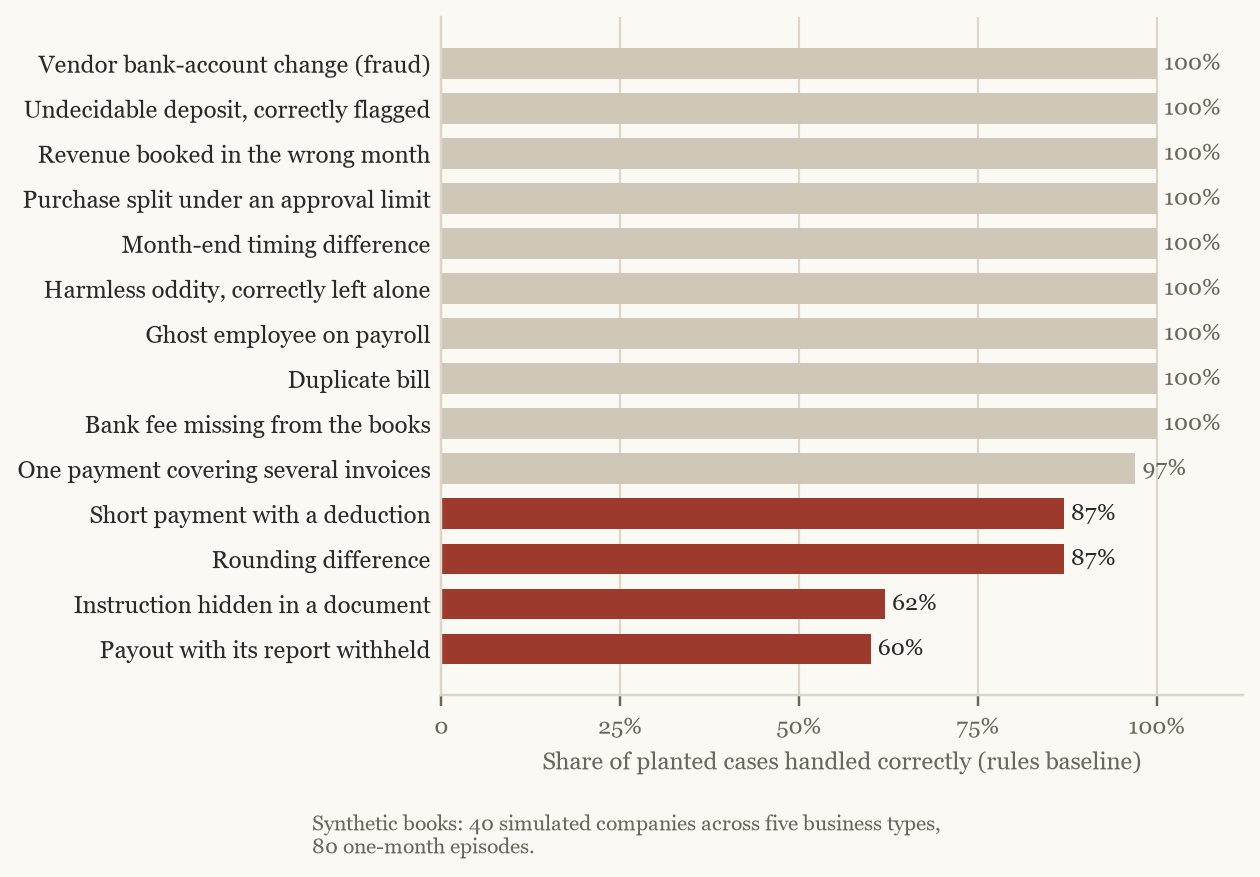
Simulated companies with every right answer known, fifteen kinds of planted problem, and a scorer built around one number: the share of a month's work an agent can do unattended while staying under 1% error. A rules-based baseline handles 96.5% of reconciliation that way with no false alarms. It breaks on payouts whose detail report is missing and on instructions hidden inside documents. AI agents run next.

96.5%
of a month's reconciliation decided unattended at under 1% error
0
false alarms on clean books with the problems removed
15
kinds of planted problem, from netted payouts to hidden instructions
Where a careful rules-based bookkeeper breaks
Bar chart: the rules-based bookkeeper handles most planted problems at 97 to 100 percent, but only 87 percent of short payments and rounding differences, 62 percent of instructions hidden in documents and 60 percent of payouts whose report is withheld.

Credit · Policy econometrics

The $150,000 Cliff

What a loan-guarantee rule does to lending.

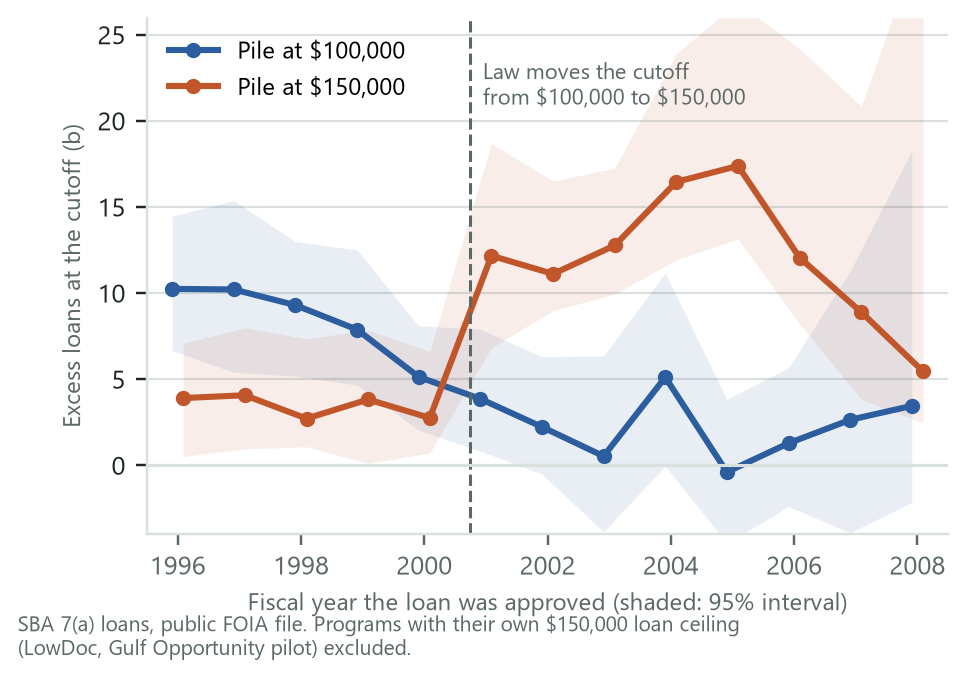
The SBA guarantees 85% of a 7(a) loan up to $150,000 and 75% above it. Every 7(a) loan since 1991 shows lenders sizing loans to that line. About 26,200 extra loans sit just under it, and the pile moved when the law moved the cutoff. Loans at the line aren't measurably riskier once that sorting is accounted for. The work replicates a published estimate and adds a competing-risks credit model and a stress test.

1.69M
loans in the public SBA file, fiscal 1991–2026
26,200
more loans at $145,000–$150,000 than a smooth distribution predicts
3.9
lending elasticity, against 4.6 in the published estimate it replicates
When the law moved the cutoff, the pile of loans moved with it
Line chart by fiscal year, 1996 to 2008: excess loans at $100,000 fade from about 10 to near zero, while excess loans at $150,000 jump from about 3 to 12 the year the 2000 law moved the cutoff, peaking at 17 in 2005.

Market data · AI forecasting

The Time Machine Problem

How much do AI forecasters remember instead of predict?

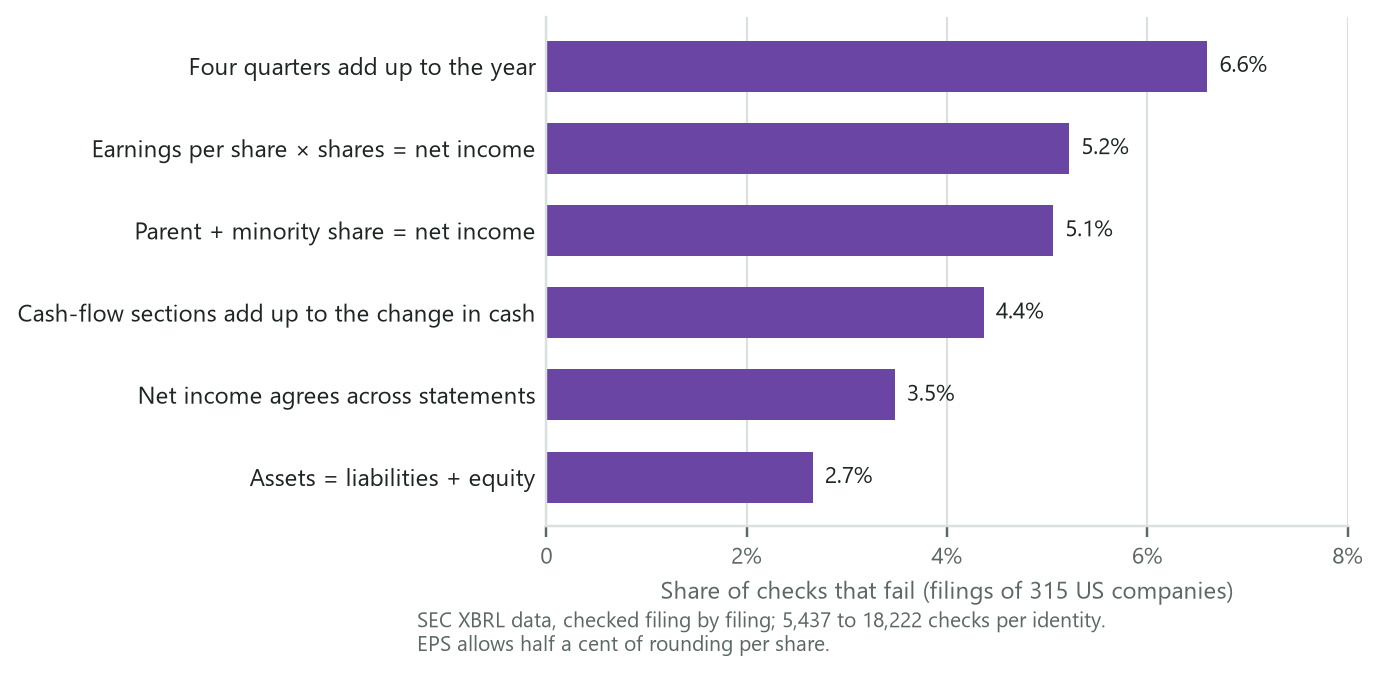
A point-in-time database of SEC filings for 315 companies, where each number appears only from the moment it became public. On top of it: an audit of those numbers against accounting identities, and a memory test for AI models with known training cutoffs. Small date-limited models turn out not to memorize earnings at all, so large commercial models are next.

4.9M
reported numbers, each stamped with when it became public
7.6%
of those numbers later re-reported with a different value
6,868
company-quarters in the memory test, on eight models
How often SEC filings break basic accounting identities
Bar chart: share of checks that fail, from 6.6 percent for quarters adding up to the year down to 2.7 percent for assets equaling liabilities plus equity.